
Riverview, FL · Garage Door Service
When Your Garage Door Comes Off Its Track
Off-track garage doors are common on Riverview's 1980s-2000s builder homes. We realign track, reset rollers, and get doors moving safely again near you.
- Repairs & new doors
- Springs & openers
- Serving 5 nearby communities
Getting It Booked In
Call us and tell us what you're seeing - a door that's cocked sideways, a panel that's bulging out of the frame, or a door that stopped moving mid-cycle with a loud bang beforehand. That detail matters because it tells us whether you're dealing with a track that's simply bent or a door that's actually jumped the rollers out of the channel entirely, which changes what we bring on the truck.
We work the Riverview area and the surrounding communities out to Bloomingdale, Gibsonton, Progress Village, Fish Hawk, and Apollo Beach, so when you call, have your address and your garage door brand or model number ready if you know it - it's usually on a sticker inside the top panel. If the door is hanging at an angle or a cable has come loose, don't try to force it up or down with the opener. That's the fastest way to turn a track repair into a full door replacement. Leave it where it sits and give us a call.
We don't do same-day emergency dispatch for every call that comes in - if a part needs to be ordered for an older or discontinued opener, we'll tell you that up front instead of guessing at a timeline.
How We Fix It
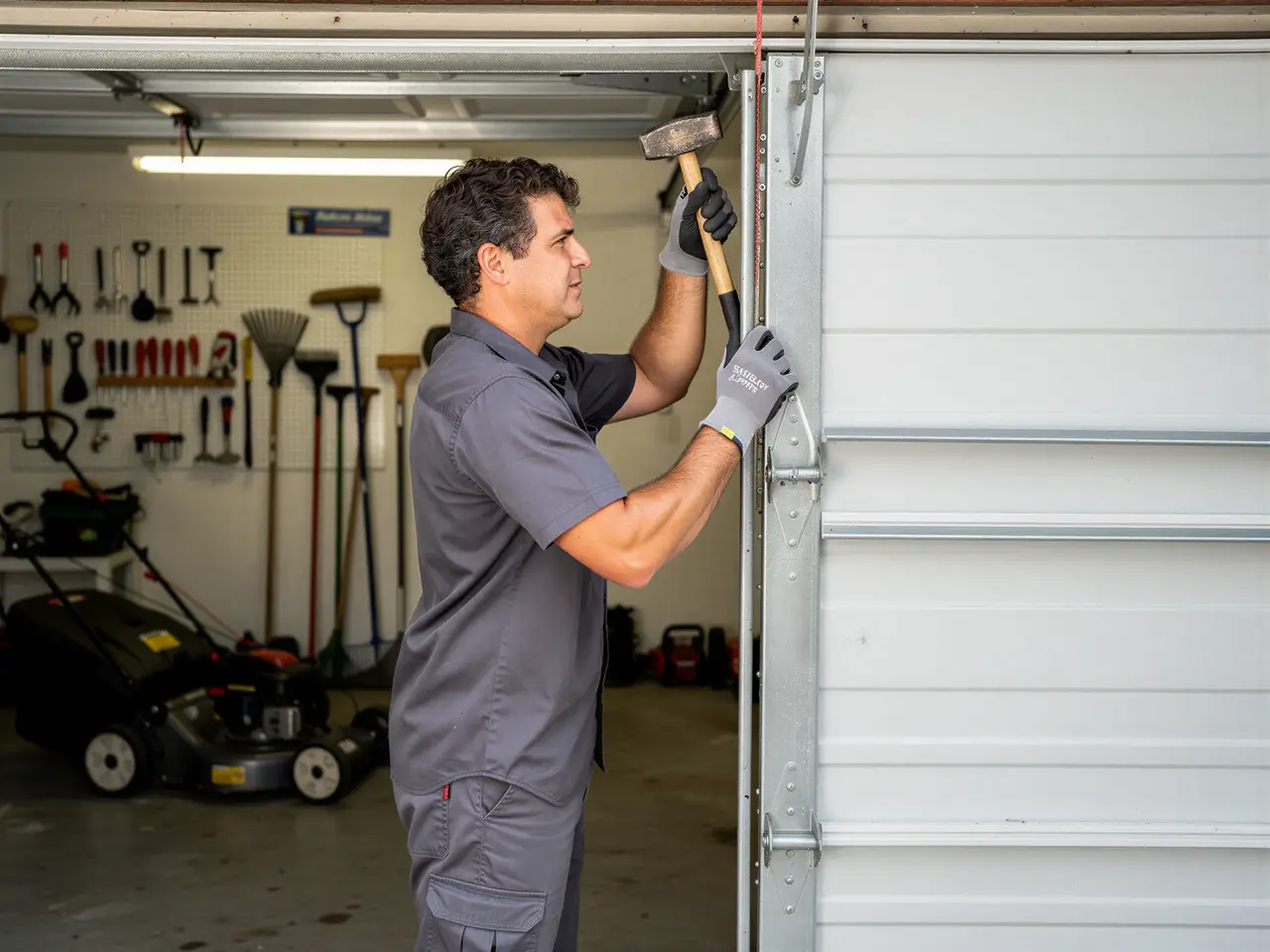
Most off-track jobs start with us pulling the door panel-by-panel off the rollers so we can see the actual shape of the track, not just the symptom. A track that's bent from an impact - a car bumper, a ladder, a kid's bike - usually gets replaced in sections rather than hammered back straight, because a track that's been bent once work-hardens at that spot and will bend again under the same stress.
If the rollers themselves are the problem - worn nylon, a bent stem, or a roller that's simply popped its bracket - we replace those and reset the door in the channel before checking that both tracks are plumb and parallel to each other. A door that runs on tracks even a half-inch out of parallel will walk itself off again within weeks, so we check that with a level, not by eye.
On double doors especially, we also check the center support and the track hangers in the ceiling, since a loose hanger lets the whole track assembly flex every time the door cycles. Here's the limitation: if the bottom bracket has pulled away from the panel or a cable has come off a drum under tension, that's not a same-visit DIY-adjacent fix - it needs the door unloaded safely first, and we won't rush that step.
What Causes It Around Here
A lot of the housing across this service area went up between 1979 and 2013, with most of it clustering in the 1980s and 90s build run across the nineteen communities we work in. That matters for this specific problem because builder-grade garage doors from that era came with steel roller track and roller brackets that were adequate for the load at the time but were never meant to run thirty-plus years without the track being re-squared.
The climate here is mild temperate, so we're not dealing with the freeze-thaw cycles that crack foundations and shift slab-mounted track hardware the way colder regions see. What we see instead is track hardware that's simply aged - brackets that have loosened a quarter-turn at a time over two or three decades of daily cycling, lag screws backing out of studs, and rollers that have worn enough that the door no longer tracks true even under normal use.
Add to that the fact that a lot of these homes still have their original door and opener, since nothing in that build era forces a replacement cycle the way a storm or a code change might. A door running on hardware installed when the house was built in, say, 1988 or 1994 is simply due for this kind of fault, independent of any one bad day.
How It Shows Up
The most obvious sign is visual - one side of the door sitting noticeably lower than the other, or a gap at the bottom where the door isn't seated square against the slab. Sometimes it's subtler: the door runs fine going up but grinds, catches, or hesitates at one specific spot every single cycle, which usually means a roller is riding on the edge of the track rather than inside the channel.
You might also hear it before you see it - a scraping or grinding noise that wasn't there last month, or a bang as a roller pops out of a bent section of track. If the opener keeps reversing the door partway through its travel, that's often the opener's safety sensor doing its job because the door isn't moving smoothly, not a sensor problem on its own.
In the worst cases the door simply stops, wedged at an angle, with a cable hanging loose or a panel visibly pulled away from the track. At that point don't keep hitting the remote - repeated attempts can bend the track further or pull a panel seam, turning a bracket-and-roller job into a panel replacement.
Frequently asked questions
Can I push my garage door back onto the track myself?
We don't recommend it. Garage doors are heavy and the track is holding that weight under tension through the springs and cables. Forcing a panel back into the channel can bend the track further, pop a cable off a drum, or drop the door on your hand. It's a short job for us with the right clamps and lifts - not worth the risk to try solo.
Is a bent track always a full replacement?
No. If the bend is minor and localized, we can sometimes replace just that section of track rather than the whole run. If the track has been bent and re-bent, or if the bend is at a hanger or support point, section replacement usually makes more sense than trying to straighten it again.
Why did my door come off track with no obvious impact?
On older builder-grade doors common across this area, it's usually gradual - a bracket that's loosened over years of cycling, a roller that's finally worn past its tolerance, or a track hanger that's backed out of the ceiling joist a little at a time. There doesn't need to be a single event for the hardware to finally give out.
How do I know if it's the track or the opener?
If the door cycles smoothly by hand with the opener disconnected but still binds or reverses when the opener runs it, the issue is more likely the opener's force settings or sensors. If it binds or grinds even moving it by hand, that points to the track, rollers, or brackets.
Related services
By Neighborhood
Off Track Repair across the Riverview area
We also handle off track repair in these Riverview-area suburbs.
Book garage door service in Riverview
Call now or request a quote - tell us what the door is doing and where you are.